| AFBF Newswatch | EPA Lawsuit | PA Dept of Ag | PFB Achievements | Career Opportunities |
Publications
Self-Marketing for Fresh Local Beef
Farm Bureau Members Take Marketing into Their Own Hands
By Darrin Youker, This e-mail address is being protected from spambots. You need JavaScript enabled to view it
For years, John Ligo would sell the occasional steer for processing for a family looking to buy beef in bulk.
But Ligo realized he was missing out on a larger market of consumers who wanted fresh local beef, but couldn’t afford to buy a half or quarter of a steer.
So Ligo, along with his wife Judy, and neighbors Russ and Crystal Carlson decided to go into business together by marketing local beef from their Mercer County farms. The Ligos and Carlsons, both Farm Bureau members, formed Pasture Perfect Beef and have begun selling at farmers markets and to commercial accounts. Both families have a combined total of around 800 cattle.
“We recognized this as a way to add more value to the animal by selling by the pound,” Ligo said.
Their plan to market local beef, however, was not without challenges.
First, the Ligos and Carlsons had to find a processer that could handle their volume of business, and was within a reasonable distance. There are only five processors to choose from in Western Pennsylvania, Ligo said.
The other was going through the state licensing requirements for selling beef. They decided to address those challenges by buying a refrigerated truck that they take to farmers markets, Ligo said.
“How to get over those hurdles is what allowed us to move ahead,” he said.
While the Ligos and Carlsons are trying to tap into the growing interest in local foods, they also have to be mindful of the costs of production. Much of the cost associated with locally-produced meats is in the production, Ligo said.
Along with having to pay a certain fee for production, Pasture Perfect beef has to pay disposal fees on parts of the animal, such as the bones and offal, that are unusable, Ligo said. Larger processors that take in thousands of animals can find markets for those byproducts that smaller producers cannot, he said.
From a production standpoint, both the Ligos and Carlsons were well versed in good agriculture practices. Their Angus beef is pasture raised on their farms.
Both have had to learn marketing, and talking to consumers about their products. But it was a task they were more than willing to take on.
“We are always interested in putting farming in a good light,” Ligo said. “We believe we are producing a superior product, and we want to tell our story.”
Bat Die Offs Threaten Agriculture
By Darrin Youker, This e-mail address is being protected from spambots. You need JavaScript enabled to view it
Should white nose syndrome continue to decimate bat populations in Pennsylvania, the state’s farming sector could be hard hit.
Experts estimate that bats provide a $292 million service to Pennsylvania agriculture through pest control and resulting higher crop yields. Bats help keep crop destroying insects under control.
Recently, the Pennsylvania Game Commission decided not to move forward with placing three bat species on the endangered species list, which could have been equally problematic to the state’s farm and forestry industries, and rural landowners.
Biologists with the Game Commission are continuing to study what causes white nose syndrome in bats, and what can be done to stem its spread.
Recently, scientists with the U.S. Geological Survey and other research institutions came up with an estimate for the financial benefit that bats provide agriculture, on a per-acre basis. Researchers found bats save more than $3 billion each year for agriculture.
Greg Turner, a biologist with the Pennsylvania Game Commission, provided some insight into the research ongoing with white nose syndrome:
How many bat colonies in Pennsylvania are known to have white nose syndrome?
Most colonies in eastern and central parts of the state have declined, while some areas are still showing good numbers, including Crawford, Venango, Somerset, Washington and Greene counties. When the disease reaches an area one year, the following year it spreads locally, and that is when we see the start of significant declines, and these declines continue into the third and fourth years. White nose syndrome has just started to establish itself in the last parts of western Pennsylvania, and neighboring parts of West Virginia and Ohio. We anticipate declines at these few sites within the next year or two.
What does the disorder do to bat populations?
Game commission data shows a 99% reduction of all species of hibernating bats combined, but with differential mortality between species. The most common species, the little brown bat, is being impacted at very high levels and drives this overall number. Because bats have only 1 pup per year, potential recovery will be lengthy, at best. We do not fully understand the total effect on populations at this time. However, bats are gregarious creatures by nature. One theory is that as the numbers decline to extremely low levels, individual bats will relocate and congregate at areas of exceptional quality.
What research is ongoing into the cause of white nose syndrome?
Research has shown a cold-loving fungus is causing the disease, and a European strain is actually even more virulent than the North American strain is to our native bats. This data shows the fungus was spread from Europe to N. America. The exact point source has not been located. Research shows the fungus causes increases in arousal rates of hibernating bats, and creates electrolyte imbalances, which leads to loss of fat reserves, neurological symptoms and excessive thirst. Treatments such as using pharmaceuticals and natural substance to minimize exposure to the fungus are being explored.
Have any possible solutions been uncovered that could assist bat populations?
No solutions have been found at this time. However, since it is documented that infected bats arouse too frequently, burning up fat reserves, recreational use of caves during the hibernation season is likely to cause additional impacts. The current management priority is to reduce human disturbances within hibernation sites during the season when used by bats, and protect maternity sites that are persisting.
New Markets for Beef
Group Helps Farmers Find New Markets for Beef
By Darrin Youker
This e-mail address is being protected from spambots. You need JavaScript enabled to view it
Glenn Eberly is a deal maker.
But the time Eberly spends working the phones, talking to farmers, is not for his own profit.
Instead, Eberly's job is to help Pennsylvania's cattle farmers find new markets and extra money for their operations.
Eberly and Blaine Winger are a two-person team of the Keystone Beef Marketing Network, an organization affiliated with the United Producers cooperative. The network was created with the assistance of the Pennsylvania Department of Agriculture and the Center for Beef Excellence.
"I try to benefit both the buyer and the seller," said Eberly, a Farm Bureau member from Mifflin County. "It does not benefit me if I sell a man's cattle."
Eberly and Winger are using state and federal grant money to find new markets for cattle. And their focus is not just at the retail level.
As part of his job, Eberly could act as a go between for a producer looking to sell feeder calves, or a farmer who wants to find cattle closer to his home operation to save on shipping costs.
"If I can move cattle from Berks to Huntingdon, the transportation cost is much less and the cattle are fresher and healthier," Eberly said.
Smaller farms, those raising 20 to 30 cattle at a time, can have a hard time getting the best return for their investment, Eberly said. That's because operations that finish cattle before slaughter are looking to buy cattle by the tractor trailer load, he said.
One area where the Keystone Beef Marketing Network can help is by assisting neighboring farms combine a shipment, and get more for their cattle, Eberly said.
That's among the reasons the marketing network is using a U.S. Department of Agriculture grant to develop a shipping facility at the Tioga Fairgrounds in Tioga County. An unused building at the fairgrounds will be renovated into a central collection point to load cattle on to tractor trailers for shipping, Eberly said.
"Most people don't have the facilities to load tractor trailers," he said.
Along with helping to develop new markets, Eberly and Winger also work with individual farms on good management practices. Those include vaccination protocols and related practices that can make for healthier cows, he said.
"A valuable part of my time is helping farms with other parts of their operation," he said. "Any way that I can act as a resource to help farmers improve their bottom line for profitability."
To learn more about the Keystone Beef Marketing Network visit: www.uproducers.com/livestock-marketing/keystone-beef-marketing.
Farm Damage
You Never Know
Karen Powell
Agricultural Risk Management Specialist
Pennsylvania Department of Agriculture
You just never know. Whether it's damaging winds and heavy rainfall from Hurricane Sandy or the extreme drought felt across much of the Midwest, we can't predict Mother Nature. Last year during the aftermath of Hurricane Lee and Tropical Storm Irene, farmers received $67 million in crop insurance payments. Now is the time to consider your 2013 risk management plans.
Important Dates or 2013 Protection
- Nov. 15 is the enrollment/policy change deadline for Pasture and Hayland Forage Rainfall Protection (PRF) for the 2013 crop year. PRF can provide you with protection against lack of rainfall (precipitation) for your pasture and hayland acreage. The program also provides apiculture protection (honeybees). This is a flexible program with no record keeping requirements.
- Nov. 20 is the enrollment/policy change deadline for apples, grapes, peaches and pears.
- Nov. 30 is the enrollment/policy change deadline for group risk all hay protection.
Report Damage Promptly
Monitor your crops for insurable damage throughout the growing and harvesting season. If you find damage notify your crop insurance agent within 72 hours of discovery, 15 days before harvesting begins and within 15 days after harvesting is completed on each affected insurance unit, but not later than Dec. 10 for corn insured as grain and soybeans. If you have grain quality problems contact your agent while evidence of damage is still in the field.
- Before you harvest direct-marketed crops, they must have a yield appraisal.
- Do not destroy evidence needed to support your claim without clear direction, in writing, from the insurance adjuster.
Whenever there is damage due to insects and/or disease it is critical to show:
- that it was uncontrollable;
- that preventative measures were taken; and
- the measures and timing of the action taken since crop damage was found.
You may want to contact your local cooperative extension agent for guidance by visiting http://extension.psu.edu/counties
Know What Protection Products Are Available
With a variety of crop insurance products available, take the time to shop for the plan or plans that will work best for your operation. Contact a crop insurance agent, set up a meeting and do your research.
Contact your crop insurance agent to learn more about what policies will work for your operation. Visit www.rma.usda.gov/tools/agent.html to find an agent. For more information, call 717-705-9511 or visit www.agriculture.state.pa.us and search "crop insurance."
Mifflin County Opens Eyes to Ag
![]() |
![]() |
|
Third grade student Josh Vance gets up close with a horse as part of an education day hosted by the Mifflin County Farm Bureau. |
Farmer Jim Hostetter talks to a group of third grade students about how cows are milked as part of an education day hosted by the Mifflin County Farm Bureau. |
Mifflin County Farm Bureau Opens Third Graders Eyes to Agriculture
This e-mail address is being protected from spambots. You need JavaScript enabled to view it
(Country Focus, October 2012)
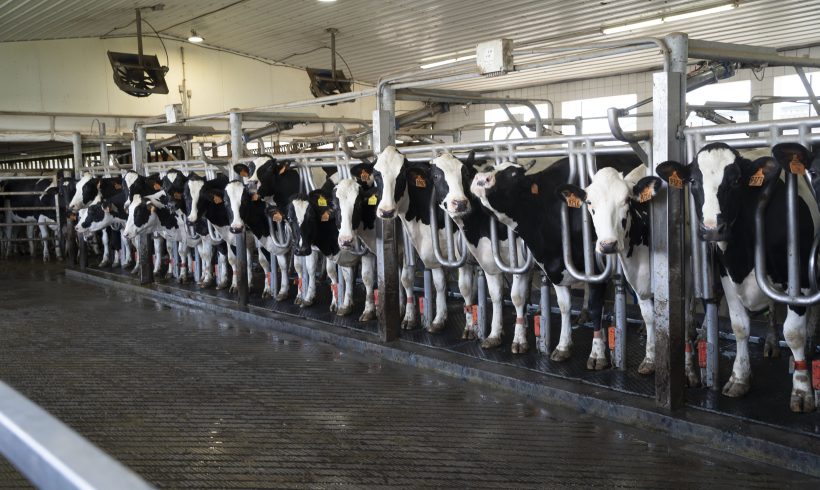
Standing inside a milking parlor, with a gaggle of third graders at his feet, Jim Hostetter gave the kids a pop quiz.
How much milk comes from a cow each day? How hot is the milk when it comes out? What else do you eat that’s made from milk?
The first two questions stumped the group of 25 third-grade students, but the group knew that ice cream, milkshakes and cheese were all made from milk.
Hostetter, a dairy farmer in Mifflin County, was participating in an agriculture education tour hosted by the Mifflin County Farm Bureau. Since 1999, Farm Bureau members have opened up their farms to third graders from every elementary school in Mifflin County.
The purpose is to give students a better understanding of the industry, clear up misconceptions, and give them a field trip that meets education standards.
“Kids need to know where their food comes from,” said Jami Glick, who along with her husband David coordinated the event. “David and I have a passion for fostering the next generation of agriculture. We want to help young people get interested in farming.”
While Mifflin County is a rural area, many of the students do not come from farming families. So it’s important for kids to understand what goes on in agriculture, said teacher Kathy Yutzy. The event hosted by the Mifflin County Farm Bureau is a great way for students to gain that understanding, she said.
“It is a fantastic experience, and its hands on,” she said. “It’s not just an isolated concept to them.”
Planning for the education day is nearly a year-long event, with much of the work focused on finding farms to host tours and recruit volunteers, Jami Glick said.
Thankfully, there are a number of people in the county who are willing to lend a hand, said Frank Bonson, Mifflin County Farm Bureau president.
“We have a real active group,” he said.
Throughout the course of a rainy September day, 500 kids broken up into two groups toured two dairy farms in the county. The kids took the rain in stride.
“I told them this is an authentic experience,” said teacher Carrie Stufft. “Farmers work in all kinds of weather.”
Students got the chance to pet a horse, learn about how crops are harvested, got lessons in pesticide safety and how milk goes from the farm to the store.
During his talk on milking, Hostetter explained to students exactly how much food comes from one dairy farm. A healthy cow can produce enough milk in one day for 200 kids to have milk on their morning cereal, Hostetter said.
“It makes you realize how much food comes from one farm,” he said. “If you remember one thing from today, I want you to remember that.”
Bill Sellers, a dairy farmer who gave a presentation to students, explained the care that farmers give to newborn calves on the farm. After all, Sellers said, they are the next generation on the farm. “They are the future, just like you are the future," he said.
Third grade student Josh Vance gets up close with a horse as part of an education day hosted by the Mifflin County Farm Bureau.
Farmer Jim Hostetter talks to a group of third grade students about how cows are milked as part of an education day hosted by the Mifflin County Farm Bureau.
More Articles...
Page 1 of 7
<< Start < Prev 1 2 3 4 5 6 7 Next > End >>